
Compare the best eSIM plans for the UK
Internet from the moment you land in the UK
By SamuelData collected on Page verified on Methodology
- Instant activation
- iPhone and Android compatible
- From €0.29 for 1 GB or more
- 6,400+ plans compared
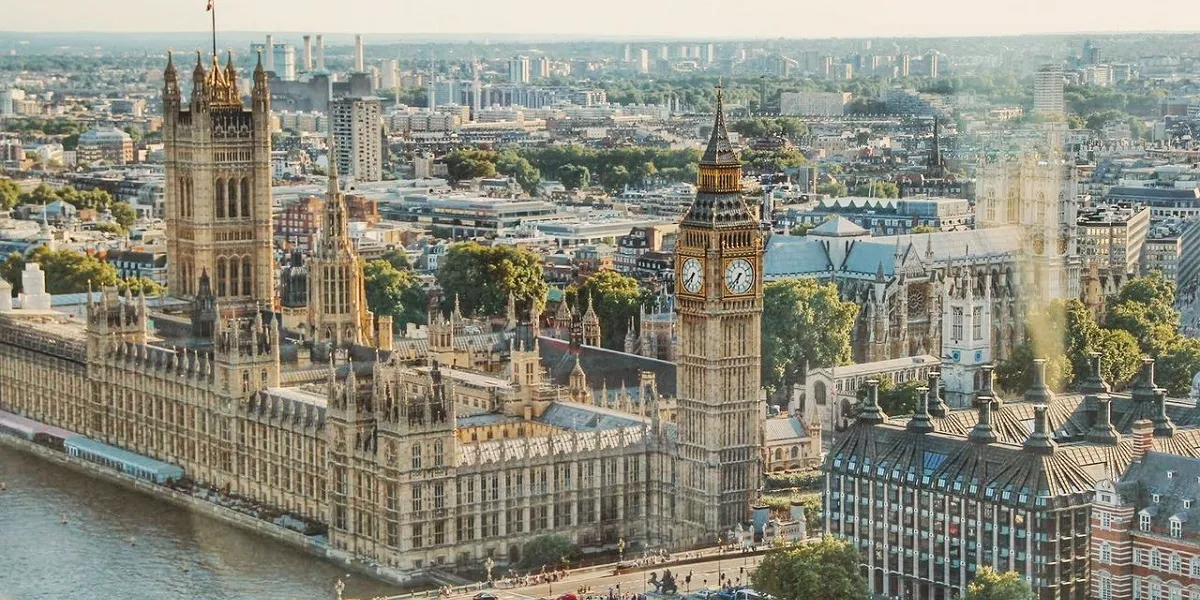
Photo credit : Dominika Gregušová
€0.29
Cheapest plan, 1 GB or more
6,400+
UK plans compared
118+
Providers available
5G
Network supported
Entry price measured on fixed-volume plans of 1 GB or more covering the country. Volumes below 1 GB and plans billed per day, whose price is not comparable, fall outside the calculation.
Best eSIM deals for United Kingdom

Stellar eSIM
1 GB · 30 days
1 GB
30 days
GB
€0.29

AbesteSIM
1 GB · 1 day
1 GB
1 day
GB
€0.30

Strongesim
1 GB · 1 day
1 GB
1 day
GB
€0.57

MicroEsim
1 GB · 1 day
1 GB
1 day
GB
€0.84

Textr eSIM
1 GB · 7 days
1 GB
7 days
GB
€0.86

Ozly eSIM
1 GB · 7 days
1 GB
7 days
GB
€0.86
eSIM for United Kingdom at a glance
From
€1.13
For 5 GB / 30 days
Plan duration
1 to 30+ days
Depending on the plan
Local networks
EE, O2, VodafoneThree
Three networks, not four, since the May 2025 merger
Average mobile speed
Around 75 Mbps
National average, Internet Society Pulse
3G network
Switched off
A 4G-capable handset is now mandatory
Entry requirement
ETA before you fly
British and Irish citizens exempt
What connectivity actually looks like on a UK trip
Three things decide how your phone behaves in Britain, and none of them are obvious from a coverage map. The country is down to three physical mobile networks after Vodafone UK and Three merged in 2025. Every one of those networks has switched 3G off for good, so an older handset that cannot do 4G is now a paperweight here. And a US carrier's international day pass is rarely the cheapest way to cover a two-week trip, which is where a travel eSIM earns its place. Speed itself is almost never the problem : the national average sits around 75 Mbps down, comfortably more than anything a traveller does on a phone.
- ●Three networks share the country : EE, long the strongest in rural areas and the Scottish Highlands, O2, and VodafoneThree, formed when the Vodafone UK and Three merger completed on 31 May 2025. A travel eSIM rides on one of those three, and which one is set by the provider's wholesale deal rather than by you.
- ●3G is gone. All three networks have retired it, so a phone that falls back to 3G for voice will struggle, and O2 stopped offering its residual 2G layer to inbound roamers in October 2025. Make sure VoLTE and Wi-Fi calling are enabled before you fly, especially on an older unlocked handset.
- ●US and Canadian travellers should compare two numbers before buying anything : the daily international pass their home carrier charges, and the cost of a UK or Europe-wide eSIM for the same stay. A ten-day trip is usually where a day pass stops being competitive.
- ●Coverage gaps are real but narrow : the inner Highlands, parts of Snowdonia, the Scottish islands, and long-distance rail journeys where signal tracks the line poorly. Everywhere else, including the busy national parks, 4G holds up.
- ●You will need an Electronic Travel Authorisation before boarding unless you hold a British or Irish passport. It is applied for online, attaches to your passport, and is unrelated to your phone, but it is the one piece of trip admin travellers most often discover too late.
Sources: Ofcom, Connected Nations 2025, Internet Society Pulse : United Kingdom, UK government : apply for an ETA
Networks and connectivity on the ground
- Average speed
- 75 Mbps downloadmeasured 2026 · Internet Society Pulse
- Coverage
- Nationwidemeasured November 2025 · Ofcom, Connected Nations
- 5G
- Widely availablemeasured November 2025 · Ofcom, Connected Nations
- Networks in service
- 5G, 4G, 2Gmeasured November 2025 · Ofcom, Connected Nations
- Local operators
- EE · O2 · VodafoneThreemeasured 2026 · Datadopt research
- Public Wi-Fi
- Everywheremeasured 2026 · Datadopt research
Practical information
- Currency
- British Pound (GBP)
- Payments
- Card accepted everywhereATMs everywhere
- Tipping
- 12.5% of the bill
- Power socket
- Type G230 V, 50 Hz
- Official languages
- EnglishAlso spoken : Welsh, Scottish Gaelic, IrishEnglish widely spoken
- Dialling code
- +44Time zone : Europe/London
- Emergency numbers
- 999
When to go
- Best time to go
- May, June, September
- Shoulder season
- April, October
- Peak season
- July, August
Britain has no dry season, so the question is never whether it will rain but what else a month gives you. May, June and September pair long evenings with manageable crowds and shoulder-season prices, which is why they beat the high summer most visitors default to.
Weather
The climate is maritime and above all changeable : one afternoon can run through a shower, a bright spell and a stiff wind. The west, Wales and the Highlands are markedly wetter than the south-east of England, so pack a shell rather than trust a forecast.
Crowds and prices
July and August are the school holidays. Timed-entry tickets for the headline attractions go weeks ahead, London and Edinburgh hotel rates peak, and the Edinburgh festivals fill the capital through August. April and October buy you the same sites for a fraction of the room rate.
Daylight
The seasonal swing is large at this latitude and larger still in Scotland than in England. June evenings stay light long past dinner, which is what makes a short trip feel generous. In December the light goes mid-afternoon, so plan one outdoor stop a day instead of three.
What is on
The calendar matters as much as the weather : the May and late-August bank holiday weekends clog the motorways and the intercity trains, while the Edinburgh Fringe, the Proms and the football season each reshape where beds are scarce. Check the dates before you fix the route.
Iconic sites and coverage
Tower of London
The Tower of London is a medieval fortress on the north bank of the Thames that served in turn as royal palace, armoury and state prison. It holds the Crown Jewels, the Yeoman Warders who guard them, and the ravens that tradition says keep the kingdom standing.
British Museum
The British Museum traces two million years of human making, from the Rosetta Stone to the Parthenon sculptures, under Norman Foster’s glazed Great Court. Entry to the permanent collection is free, which also makes it the best wet-afternoon plan in central London.
Stonehenge
Stonehenge is a late Neolithic stone circle raised on Salisbury Plain, its principal axis aligned on the midsummer sunrise. Visitors follow a path around the stones rather than through them, so the monument is read from its circumference.
Edinburgh Castle
Edinburgh Castle sits on a volcanic plug above the Old Town, closing the top of the Royal Mile. Inside are the Honours of Scotland, the Stone of Destiny and the One O’Clock Gun, fired every day except Sunday.
Giant's Causeway
The Giant’s Causeway is a field of tens of thousands of interlocking basalt columns on the Antrim coast, left by a cooling lava flow. Local legend credits it to the giant Finn McCool, building a road to meet his Scottish rival.
Yr Wyddfa (Snowdon)
Yr Wyddfa, Snowdon in English, is the highest mountain in Wales and the centrepiece of Eryri national park. Several paths of very unequal difficulty reach the summit, as does the Llanberis rack railway when conditions at the top allow.
Isle of Skye
Skye is the largest of the Inner Hebrides, joined to the mainland by a bridge and known for the Cuillin ridge, the Old Man of Storr and the Fairy Pools. Distances mislead : single-track roads set a far slower pace than the map suggests.
Lake District
The lakes and fells of north-west England make up the country's largest national park, with waymarked paths that climb quickly and weather that changes quicker still. Signal drops as soon as you leave the valleys, and a paper map is not an excessive precaution here.
Entry and health
- Visa
- Travel authorisation requiredmeasured 2026 · Destination country's consular authorityPermitted length of stay : 180 daysApply
Sources Internet Society Pulse, Ofcom, Connected Nations, Datadopt research, Destination country's consular authority
Datadopt Observatory
Price per GB in the United Kingdom: what our data shows
According to the Datadopt Observatory, the lowest price per GB recorded in the United Kingdom comes down to 0.10 €/GB, across a sample of 2,794 fixed-volume offers retained for the measurement. That floor is reached on large data bundles : a 5 GB plan over 30 days costs noticeably more per GB. The real differentiator is still the depth of the offer : the more plans compete, the easier it is to find the duration and data volume that fit your trip.
Lowest price per GB recorded
0.10 €/GB
Offers in the price sample
2,794
Europe average
0.12 €/GB
World ranking
52 / 215
United Kingdom is 17% cheaper than the Europe regional average (0.12 €/GB).
Source: Datadopt eSIM Price Observatory, 170,286 plans analysed, measured 1 September 2026.
See the eSIM price Observatory by country →Which eSIM providers for United Kingdom?
Here are the 6 best-placed eSIM providers for United Kingdom, ranked by best price per GB. Prices are expressed per GB so plans of different sizes can be compared on the same basis.
| Provider | Price per GB | From | Max duration | Hotspot | 5G |
|---|---|---|---|---|---|
| AbesteSIM | 0.26 €/GB | 0.30 € | 15 d | Yes | No |
| Stellar eSIM | 0.28 €/GB | 0.29 € | 30 d | Yes | Yes |
 eSIM.dog | 0.47 €/GB | 0.90 € | 30 d | Yes | No |
| 0.52 €/GB | 1.24 € | 7 d | Yes | No | |
| Strongesim | 0.53 €/GB | 0.57 € | 15 d | Yes | Yes |
| MicroEsim | 0.69 €/GB | 0.84 € | 7 d | Yes | No |
Providers ranked by best price per GB, across plans of at least 1 GB. Source: Datadopt catalogue.
Compare all plans →Device compatibility
eSIM is built into every iPhone XS and later, as well as Samsung Galaxy S20+, Google Pixel 3a+ and most high-end Motorola, Oppo, Sony and Xiaomi models.
Not sure about your device? Check compatibility here.
How to install your eSIM for United Kingdom
- 1. Compare offers on https://www.datadopt.com/en/compare/gb
- 2. Browse our partners' eSIM offers and choose the data volume and duration that fit your trip.
- 3. Purchase the eSIM plan that best fits your needs on our partner's site.
- 4. Receive a QR code by email after purchase.
- 5. Before you leave or during your stay, add the eSIM to your smartphone (Note: a stable Wi-Fi connection may be required during this step.)
- 5.1. On iPhone: Settings > Mobile Data > Add Plan > Scan the QR code
- 5.2. On Android: Settings > Connections > SIM card manager > Add a mobile plan
- 6. Once you arrive, turn on the data of your eSIM and enjoy reliable internet in the United Kingdom.
First eSIM? The full walkthrough, with iOS and Android screenshots, lives in our guide how to install an eSIM on your smartphone.
Frequently asked questions
Which network will my eSIM connect to in the UK?
One of the country's three physical networks : EE, O2 or VodafoneThree. The provider's wholesale agreement decides, not you, and most providers do not publish it. If it matters for your itinerary, for instance because you are spending time in the Highlands where EE has historically been strongest, ask the provider before you buy.
Is a travel eSIM cheaper than my carrier's international day pass?
It depends on the length of the trip. A day pass is simple and fine for a long weekend. Past roughly a week, the arithmetic usually flips : a single UK or Europe-wide eSIM for the whole stay costs less than the same number of daily charges. Work out both numbers for your actual trip length rather than assuming either way.
Will my phone work now that 3G is switched off?
Yes if it is a 4G or 5G handset, which covers every phone sold in the last decade or so. An older device limited to 2G and 3G is effectively unusable in Britain : all three networks have retired 3G, and O2 closed its residual 2G layer to inbound roamers in October 2025. Check that VoLTE and Wi-Fi calling are switched on before you travel.
How much data should I budget for a UK trip?
For a week in London using maps, transit apps and messaging, 3 to 5 GB is comfortable. For two weeks with regular video and browsing, aim for 10 GB. Free Wi-Fi is everywhere in pubs, cafés, museums and railway stations, which pulls real mobile consumption well below what the same trip would use in a less connected country.
Do eSIMs work on the London Underground?
On part of the network. Around 60 % of subterranean stations are fitted, 62 out of 121, and the Elizabeth line has been covered throughout since December 2024. Transport for London is targeting the whole network by the end of 2026. At an unfitted station you are offline until you resurface, so download your route in advance.
Do I need an ETA to enter the UK?
Unless you hold a British or Irish passport, yes. The Electronic Travel Authorisation is applied for online before you travel and attaches to your passport. Processing is usually a few working days, so it is not something to leave to the night before departure.
How much does an eSIM cost in the United Kingdom, and is it cheap?
According to the Datadopt Observatory, the lowest price per GB recorded in the United Kingdom comes down to 0.10 €/GB, across a sample of 2,794 fixed-volume offers retained for the measurement. That floor is reached on large data bundles : a 5 GB plan over 30 days costs noticeably more per GB. The real differentiator is still the depth of the offer : the more plans compete, the easier it is to find the duration and data volume that fit your trip. United Kingdom is 17% cheaper than the Europe regional average (0.12 €/GB). In our global ranking of well-covered eSIM markets, United Kingdom sits at position 52 of 215 by price per GB (1 = cheapest). Source: Datadopt eSIM Price Observatory, 170,286 plans analysed, measured 1 September 2026.
See the eSIM price Observatory by country →Explore other popular destinations
Ready to stay connected in the United Kingdom?
Compare the best eSIM offers and enjoy data the moment you arrive, at the best price.