
Compare the best eSIM plans for Australia
Internet from the moment you land in Australia
By SamuelData collected on Page verified on Methodology
- Instant activation
- iPhone and Android compatible
- From €0.31 for 1 GB or more
- 5,100+ plans compared
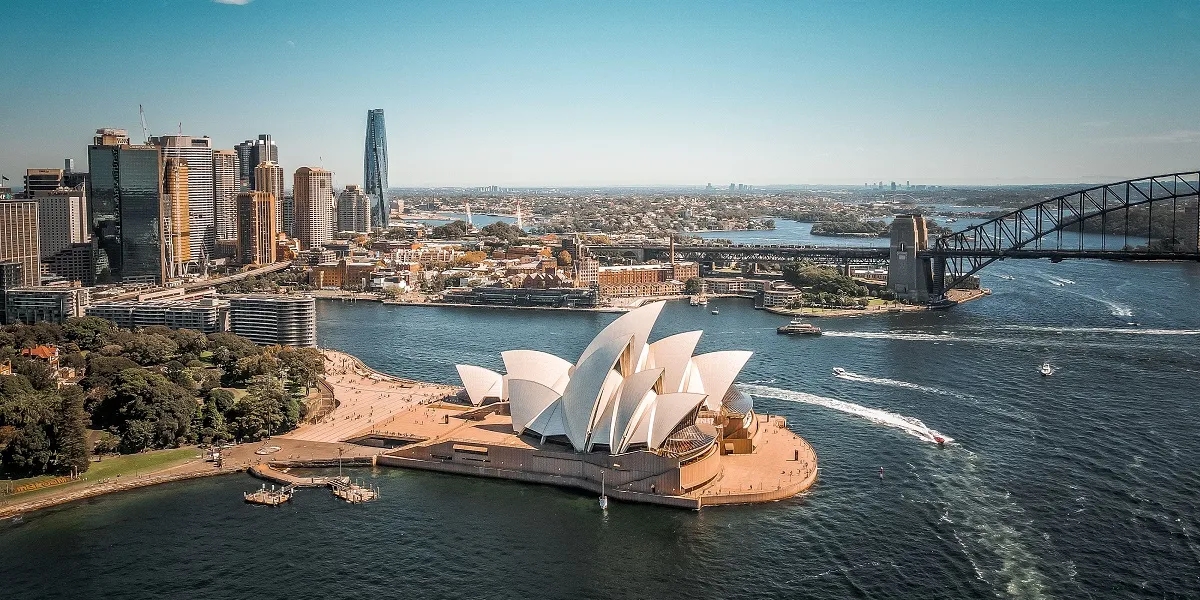
Photo credit : Parth Patel
€0.31
Cheapest plan, 1 GB or more
5,100+
Australia plans compared
120+
Providers available
5G
Network supported
Entry price measured on fixed-volume plans of 1 GB or more covering the country. Volumes below 1 GB and plans billed per day, whose price is not comparable, fall outside the calculation.
Best eSIM deals for Australia

AbesteSIM
1 GB · 1 day
1 GB
1 day
AU
€0.31

Stellar eSIM
1 GB · 7 days
1 GB
7 days
AU
€0.43

eSIM.dog
1 GB · 1 day
1 GB
1 day
AU
€0.65

Strongesim
1 GB · 7 days
1 GB
7 days
AU
€0.74

MicroEsim
1 GB · 1 day
1 GB
1 day
AU
€0.83

Ozly eSIM
1 GB · 7 days
1 GB
7 days
AU
€0.99
eSIM for Australia at a glance
From
€2.10
For 5 GB / 30 days
Plan duration
1 to 30+ days
Depending on the plan
Local networks
Telstra, Optus, Vodafone Australia
5G in cities, 4G elsewhere
VPN needed?
No
All Western services work normally
Hotspot tethering
Available
On most plans
Compatibility
iPhone XS+ / Android 8.0+
Check your device
Internet in Australia: everything you need to know
Australia shows an internet penetration rate of around 96% and one of the best mobile footprints in Oceania (source: ITU DataHub, 2024). Telstra runs the most extensive network : critical in the outback and rural areas : while Optus and Vodafone are competitive in urban zones. 5G is available across every major city and its suburbs. An Australia eSIM gets you onto this network the moment you land at Sydney, Melbourne, Brisbane or Perth.
- ●5G coverage in every major city (Sydney, Melbourne, Brisbane, Perth, Adelaide, Canberra) and their suburbs.
- ●Average mobile download speeds around 90 to 110 Mbps per Ookla (Q1 2025).
- ●Perfect for Uber, Google Maps, camping apps (WikiCamps), and national-park bookings.
- ●Vast outback areas with no cellular coverage: plan offline maps for road-trips to Uluru, the Kimberley or Flinders Ranges.
Sources: Internet Society Pulse : Australia, ITU DataHub : Australia statistics, Ookla Speedtest Global Index
Networks and connectivity on the ground
- Average speed
- 121.4 Mbps downloadmeasured 2026 · Internet Society Pulse
- 5G
- Widely availablemeasured 2025 · Internet Society Pulse
- Local operators
- Telstra · Optus · Vodafone AUmeasured 2026 · Datadopt research
- Public Wi-Fi
- Widely availablemeasured 2026 · Datadopt research
Practical information
- Currency
- Australian Dollar (AUD)
- Payments
- Card accepted everywhereATMs everywhere
- Tipping
- Tipping is not expected
- Power socket
- Type I230 V, 50 Hz
- Official languages
- EnglishEnglish widely spoken
- Dialling code
- +61Time zone : Australia/Perth, Australia/Darwin, Australia/Adelaide, Australia/Brisbane, Australia/Sydney
- Emergency numbers
- 000
When to go
- Best time to go
- March, April, May, September, October, November
- Shoulder season
- June, August
- Peak season
- December, January
- Seasonal hazards
- CyclonesNovember, December, January, February, March, April
- Extreme heatDecember, January, February
- WildfiresDecember, January, February
The seasons are reversed: December is summer and July is winter. March to May and September to November are the two windows that work from the tropical north to the temperate south, when the north is out of the wet and the south is not yet flattened by heat.
Coverage stops where the people stop
The facts block below reports population coverage, and the population lives on the south-eastern coast. The outback is a different country for a phone: long stretches of highway with nothing, which is exactly where a working map matters most.
Two climates, not one
The north, Darwin to Cairns, runs on a wet season from November to April and a dry one the rest of the year. The south, Perth to Melbourne, has four temperate seasons. The same month can be ideal in one and inadvisable in the other.
The sun is harsher than you are used to
UV readings regularly exceed the highest European levels, including under cloud. Serious burns happen in under an hour in summer, and the local public-health advice comes down to five habits worth adopting on arrival.
The wildlife advice is practical, not folklore
Swim between the flags, do not swim in northern rivers or estuaries, wear a stinger suit from November to May in the tropics, and watch your feet on bush trails. None of it is dramatic and all of it is standard here.
Iconic sites and coverage
Sydney Opera House
Jørn Utzon's concrete shells, set on a point in the harbour, are clad in a million white and cream tiles you only register up close. The guided tour goes inside the halls, and walking the perimeter is free.
Great Barrier Reef
Two thousand kilometres of reef off Queensland, the largest coral system on earth. Trips leave from Cairns or Airlie Beach, signal ends offshore, and coral condition varies widely from site to site.
Uluru
A red sandstone monolith in the centre of the country, sacred to the Anangu, with climbing banned since 2019. The base walk takes three hours on foot, early in the day, and the colour shifts by the hour.
Twelve Apostles
Limestone stacks cut loose from the cliff on the Great Ocean Road west of Melbourne. Fewer than twelve remain, the erosion continues, and the Bass Strait wind never stops.
Bondi Beach
Sydney's city beach, with its surf club, its ocean pool and the coast path running south to Coogee. It is full on summer weekends, and the rips are real despite the patrols.
Daintree Rainforest
The oldest tropical rainforest on earth, north of Cairns, running right down to the sea. Access is by ferry, swimming is inadvisable because of saltwater crocodiles, and signal disappears under the canopy.
Kakadu National Park
Twenty thousand square kilometres in the Northern Territory, with rock art tens of thousands of years old and crocodiles in the thousands. Tracks close through the wet season, and you go in offline.
Melbourne Laneways
A network of service alleys turned into cafes, bars and painted walls that change constantly. It is the heart of Australian coffee culture, and none of it is visible from the main streets.
Sources Internet Society Pulse, Datadopt research
Datadopt Observatory
Price per GB in Australia: what our data shows
According to the Datadopt Observatory, the lowest price per GB recorded in Australia comes down to 0.09 €/GB, across a sample of 2,123 fixed-volume offers retained for the measurement. That floor is reached on large data bundles : a 5 GB plan over 30 days costs noticeably more per GB. The real differentiator is still the depth of the offer : the more plans compete, the easier it is to find the duration and data volume that fit your trip.
Lowest price per GB recorded
0.09 €/GB
Offers in the price sample
2,123
Oceania average
0.25 €/GB
World ranking
48 / 215
Australia is 64% cheaper than the Oceania regional average (0.25 €/GB).
Source: Datadopt eSIM Price Observatory, 170,286 plans analysed, measured 1 September 2026.
See the eSIM price Observatory by country →Which eSIM providers for Australia?
Here are the 6 best-placed eSIM providers for Australia, ranked by best price per GB. Prices are expressed per GB so plans of different sizes can be compared on the same basis.
| Provider | Price per GB | From | Max duration | Hotspot | 5G |
|---|---|---|---|---|---|
| Stellar eSIM | 0.30 €/GB | 0.43 € | 30 d | Yes | Yes |
| AbesteSIM | 0.31 €/GB | 0.31 € | 30 d | Yes | No |
| eSIM.dog | 0.39 €/GB | 0.65 € | 30 d | Yes | No |
| MicroEsim | 0.53 €/GB | 0.83 € | 30 d | Yes | No |
| Strongesim | 0.60 €/GB | 0.74 € | 30 d | Yes | Yes |
| Ozly eSIM | 0.61 €/GB | 0.99 € | 15 d | Yes | No |
Providers ranked by best price per GB, across plans of at least 1 GB. Source: Datadopt catalogue.
Compare all plans →Device compatibility
eSIM is built into every iPhone XS and later, as well as Samsung Galaxy S20+, Google Pixel 3a+ and most high-end Motorola, Oppo, Sony and Xiaomi models.
Not sure about your device? Check compatibility here.
How to install your eSIM for Australia
- 1. Compare offers on https://www.datadopt.com/en/compare/au
- 2. Browse our partners' eSIM offers and choose the data volume and duration that fit your trip.
- 3. Purchase the eSIM plan that best fits your needs on our partner's site.
- 4. Receive a QR code by email after purchase.
- 5. Before you leave or during your stay, add the eSIM to your smartphone (Note: a stable Wi-Fi connection may be required during this step.)
- 5.1. On iPhone: Settings > Mobile Data > Add Plan > Scan the QR code
- 5.2. On Android: Settings > Connections > SIM card manager > Add a mobile plan
- 6. Once you arrive, turn on the data of your eSIM and enjoy reliable internet in Australia.
First eSIM? The full walkthrough, with iOS and Android screenshots, lives in our guide how to install an eSIM on your smartphone.
Frequently asked questions
Do eSIMs really work in Australia?
Yes. The vast majority of international eSIMs connect to Telstra, Optus or Vodafone Australia the moment you land at Sydney, Melbourne or Brisbane.
Do I need a VPN in Australia?
No. All Western services (Google, WhatsApp, Instagram, X, YouTube) work normally.
Can I keep my home phone number?
Yes. The Australia eSIM installs alongside your main line. You keep your home number for bank SMS and two-factor codes.
What's the best eSIM for an outback road-trip?
Telstra has historically the best rural coverage. For a Sydney-Uluru-Darwin or Perth-Broome trip, prefer eSIMs that mention Telstra; other carriers have significant coverage gaps.
How much data for a 3-week trip to Australia?
For a classic coastal road-trip with heavy use of maps, weather, bookings, camping apps and video calls, target 20 to 30 GB. For a shorter urban stay, 10 to 15 GB is enough.
Can I share my connection with other devices?
Most Australia eSIM plans allow hotspot tethering. The detail appears on each plan page on Datadopt.
How much does an eSIM cost in Australia, and is it cheap?
According to the Datadopt Observatory, the lowest price per GB recorded in Australia comes down to 0.09 €/GB, across a sample of 2,123 fixed-volume offers retained for the measurement. That floor is reached on large data bundles : a 5 GB plan over 30 days costs noticeably more per GB. The real differentiator is still the depth of the offer : the more plans compete, the easier it is to find the duration and data volume that fit your trip. Australia is 64% cheaper than the Oceania regional average (0.25 €/GB). In our global ranking of well-covered eSIM markets, Australia sits at position 48 of 215 by price per GB (1 = cheapest). Source: Datadopt eSIM Price Observatory, 170,286 plans analysed, measured 1 September 2026.
See the eSIM price Observatory by country →Explore other popular destinations
Ready to stay connected in Australia?
Compare the best eSIM offers and enjoy data the moment you arrive, at the best price.